The short answer
- You need sound at your ceremony: mics for the officiant and vows, plus processional music. Without it, most guests will not hear what is said.
- Cocktail hour needs background music so the room does not feel empty while photos happen.
- A DJ is the simplest way to cover both. Live musicians or the venue's house system can work, but someone still has to handle mics and cues.
Many couples book a DJ for the reception and treat the ceremony and cocktail hour as an afterthought. Then, a few weeks out, they realize nobody is bringing mics for the vows or playing the processional. The ceremony is the most important 20 to 30 minutes of the day, and it is the part where sound problems hurt most.
You do not always need a DJ for these parts. You do need someone who owns them.
What the ceremony actually needs
A wedding ceremony has three sound jobs. Each one can go wrong in a different way.
- Mic the officiant. A wireless lavalier clipped to the officiant (or the person getting married) picks up the vows and the ring exchange.
- Mic readers and musicians. A handheld wireless mic on a stand for readings, a poem or a family blessing.
- Play the music on cue. Seating music, the wedding party processional, the entrance song, the recessional, and quiet music for a unity ceremony or signing.
- Fill the space with sound. Speakers placed so the back row hears as well as the front, without feedback.
- Watch the timing. Someone has to see the doors open and fade the song at the right moment.
Outdoor ceremonies add wind, distance from power and open air that swallows voices. Our guide to outdoor wedding ceremony sound covers mics, battery speakers and windscreens in detail.
Even a small ceremony of 40 guests benefits from a mic. Vows are spoken quietly and often facing each other, not the crowd. Without amplification, guests past the third row usually miss them.
What cocktail hour needs
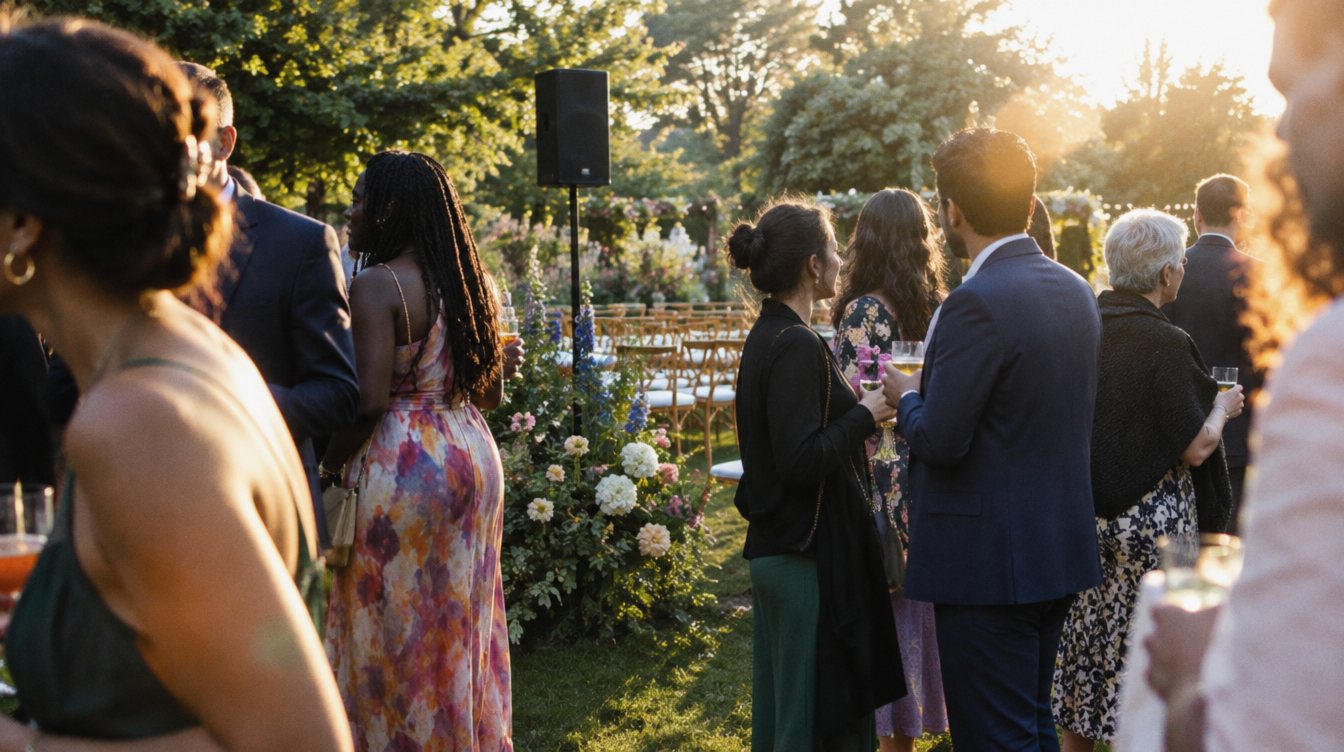
Cocktail hour is easier. It needs pleasant background music at a volume where people can still talk, and sometimes a mic for an announcement ("dinner is served" or "please find your seats"). The challenge is location: cocktail hour is often in a different space from both the ceremony and the reception, and the reception room is being set while it happens.
That is why the question is not only "who plays music" but "how many sound systems do we need." If your ceremony, cocktail hour and reception are in three separate spots, a DJ with one system has to tear down and rebuild between them, which means gaps in music and rushed setup.
Your options, compared
| Option | Works well when | Watch out for |
|---|---|---|
| Your DJ, all day | You want one team handling every mic, cue and song | Confirm a separate sound system for each space if they are apart |
| Live musicians | You love the look and feel of live strings or acoustic guitar | Musicians still need mics for the officiant and readers; someone has to run them |
| Venue house sound | The venue has a built-in system and staff to run it | Ask who operates it, and whether it reaches the ceremony site |
| A friend with a speaker | Tiny, informal ceremonies with no mics needed | Missed cues, dead batteries, phone notifications through the speaker |
Combining options works too. Many couples hire musicians for the processional and let the DJ handle mics, the recessional and cocktail hour. The key is deciding in advance who is responsible for each cue. Our DJ vs band guide covers the tradeoffs of live music in more depth.
What it usually costs to add
Adding ceremony and cocktail hour coverage to a reception-only DJ booking usually means more hours plus extra equipment. Across Southern California, full-day DJ packages that include the ceremony and cocktail hour typically cost several hundred to about $1,500 more than reception-only coverage from the same DJ, based on our research into published packages. Our wedding DJ cost guide has the full ranges.
In our Full Wedding package, the ceremony, cocktail hour and reception each get their own sound system, so nothing gets torn down in the middle of the day. That matters most when the three spaces are apart.
When you can skip it
You might skip the DJ for these parts if
- Your ceremony is very small and indoors
- The venue provides house sound with a technician
- Live musicians are covering the music and someone is handling mics
- Cocktail hour is in the same room as the reception, already set up
You probably want full-day coverage if
- Your ceremony is outdoors or has more than about 50 guests
- Ceremony, cocktail hour and reception are in different spaces
- You want specific songs timed to your entrance
- You do not want to manage mics and cues yourselves
Whoever runs your ceremony sound should be a professional, not a guest. Missed cues and silent vows are the hardest wedding moments to fix later.
How to plan ceremony music with your DJ
- Pick your songs. Prelude or seating music, processional for the wedding party, entrance song, any interlude music, and the recessional. Our wedding song list has ideas for each moment.
- Mark the exact start points. Many entrance songs work best starting at a chorus or a specific instrumental moment. Tell your DJ where.
- Agree on cues. Who signals the DJ when the doors open? Usually the coordinator. Write it down.
- Confirm the mic plan. Who wears the lavalier, who uses the handheld, and whether any readers are nervous and need a quick practice.
- Do a sound check. The DJ should test mics and speakers at the ceremony site before guests arrive.
Frequently asked questions
Can our DJ play the ceremony and the reception in different locations?
Yes, but ask how. Either they bring separate systems for each space or they move one system, which creates a gap. Separate systems are smoother when spaces are apart.
Do we need a mic for a small ceremony?
For more than a few dozen guests, or any outdoor ceremony, yes. Vows are usually spoken softly and toward each other, so a mic is the only way most guests will hear them.
Can our officiant use the venue's mic?
If the venue has a working system that reaches the ceremony site and someone to run it, yes. Confirm who operates it and test it before guests arrive.
Is cocktail hour music really necessary?
Not strictly, but a quiet room feels awkward while guests wait for you to finish photos. Light background music sets the mood for the reception.