The short answer
- Yes, in most cases. Vendors who work through dinner (DJ, photographer, videographer, planner, booth attendant) usually have a meal clause in their contract.
- A vendor meal does not have to be the guest entree. Most caterers offer a lower priced vendor plate, but ask for a hot meal, not a sandwich.
- Feed vendors at the same time as your guests, not after. The best photos and the smoothest reception depend on it.
Vendor meals are one of those line items couples find late in planning, usually when the caterer asks for a final headcount. The rule is simple: if someone is working your wedding for six or more hours, including the dinner hour, plan to feed them. Most professional contracts say so in writing, and even when one does not, it is the normal courtesy in the wedding industry.
This guide covers who counts as a vendor for meal purposes, what to serve, how to budget for it and the timing detail that matters more than the menu.
Who needs a vendor meal
The working test is "on site through dinner." Anyone who arrives before the meal and stays after it needs to eat. Vendors who drop off and leave do not.
- DJ and MC (and any assistant or lighting tech)
- Photographer and second shooter
- Videographer and second shooter
- Wedding planner or day-of coordinator, plus their assistant
- Photo booth or video booth attendant
- Live musicians who play through dinner, such as a string quartet that stays for cocktail hour and the reception
- Officiant, only if they are staying for the reception
Who usually does not need one: the florist, the cake baker, rental delivery crews and the hair and makeup team. They set up or finish early and leave. Catering and venue staff are fed by their own employer.
Read each contract for the exact wording. Some say "a hot meal for each team member on site," some say "the same meal as guests," and a few list a fee if no meal is provided. Count heads from the contracts, not from memory.
Do you have to serve them the guest meal?
No. Most caterers have a vendor meal option that costs less than the guest plate. It is usually a simplified version of the main course or a chef's choice entree. What matters is that it is a real meal: something hot and filling, served on a plate, that a person who has been on their feet since early afternoon can eat in ten minutes.
Guest entree
- Same plate your guests get
- Full guest price per head
- Some contracts ask for this; most do not
- Simplest to order if your guest count is small
Caterer's vendor meal
- A simplified hot plate, often the same protein
- Usually priced well below the guest entree
- Meets the "hot meal" wording in most contracts
- Ask your caterer for it by name
What to avoid: a boxed sandwich, a bag of chips, or "they can grab something from the buffet when there is a lull." There is rarely a lull. A tired, hungry crew is not a crew doing its best work in the last two hours of the night, which is exactly when your dance floor peaks and your send-off happens.
Also tell the caterer about dietary needs. Ask each vendor ahead of time if anyone is vegetarian, vegan or has an allergy, and pass it along with the count.
How much vendor meals cost
There is no single vendor meal price. It follows your caterer's pricing, and that varies a lot by region and service style. Recent national planning guides put full wedding catering at roughly $40 to $65 per person for a buffet and $65 to $85 per person for a plated dinner, with major metro areas like Los Angeles often running higher. Vendor meals are usually discounted from those numbers. Your caterer's proposal is the only figure that counts, so ask for the vendor rate in writing.
| Wedding size | Typical vendors on site at dinner | Meals to plan |
|---|---|---|
| Small (under 75 guests) | DJ, photographer, coordinator | 3 to 4 |
| Mid size (75 to 175 guests) | DJ, photo, video, coordinator, booth | 5 to 8 |
| Large or multi-day | Full team with second shooters, assistants, musicians | 8 to 12 or more |
These are planning counts, not rules. Your own number comes from your contracts. Build the line into your catering budget early so it is not a surprise at the final headcount.
When vendors should eat
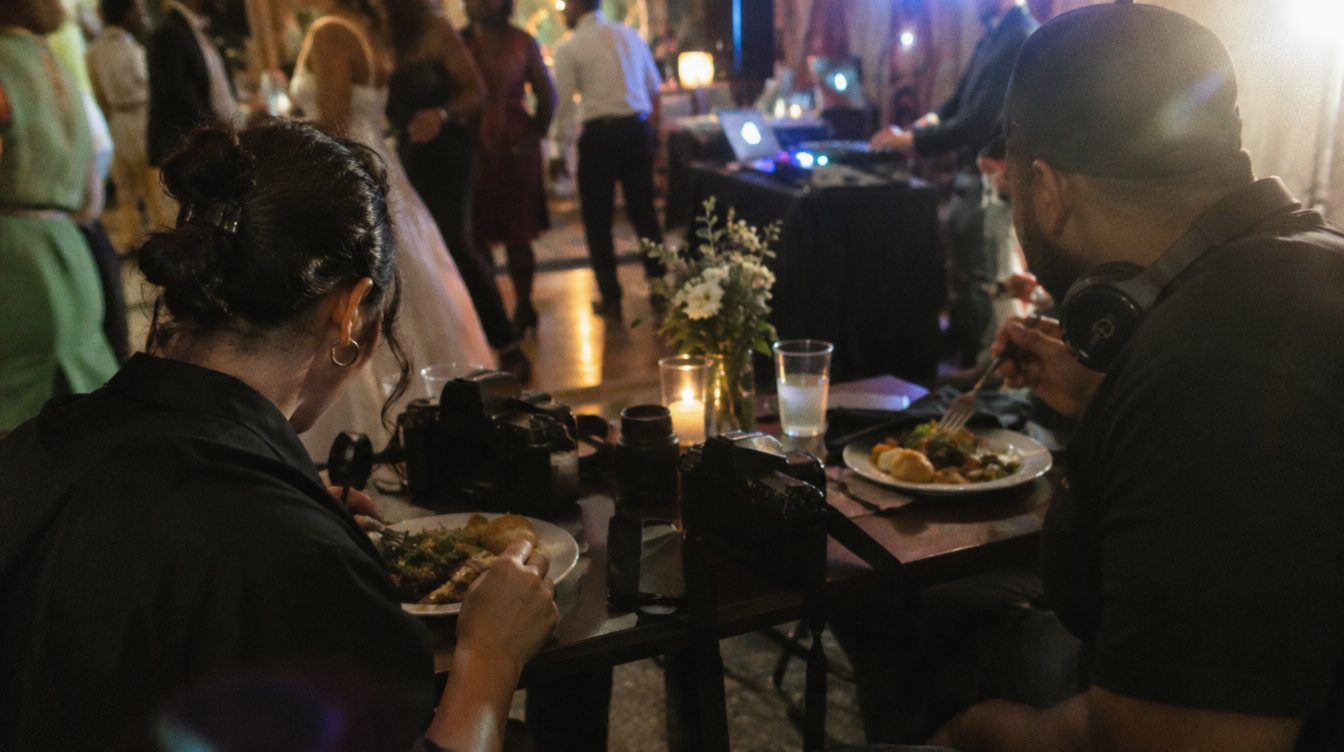
This is the part couples get wrong most often, and it matters more than the menu. Vendors should eat at the same time as your guests, ideally right after the head table is served.
Why: dinner is the one quiet stretch of the reception. Nobody wants photos of guests chewing, and the DJ is playing a background set. The moment dinner ends, everything starts at once: toasts, first dance, parent dances, cake, open dancing. If your photographer is served last, they are eating when your best man stands up. If your DJ and MC are served last, they are eating when it is time to introduce the toasts.
- Guests seated, head table served first
Your photographer catches the first plates and the room while it still looks fresh.
- Vendors served
Ask the caterer to serve vendors right after the head table, at a table close to the room.
- Vendors done and back in position
Twenty to twenty five minutes is enough. Your crew is ready before the plates are cleared.
- Toasts begin
Everyone who needs to capture or run this moment is fed and in place.
If your reception order puts toasts during dinner, adjust so vendors still eat before or between toasts. Our wedding reception timeline walks through a full evening with these handoffs in mind.
Feed your crew when your guests eat, not after. The ten minutes you save them is the ten minutes they spend in position for your toasts.
Where vendors should eat
A small table near the reception room, or a reserved spot just outside it, is ideal. Your DJ needs to hear the room and get back to the booth fast, and your photographer needs to see when the toasts are about to start. A vendor table across the property or in a back hallway adds minutes each way.
Some couples seat vendors at a guest table that has open seats. That works too, as long as it is close to the action. Do tell your coordinator or venue captain where the vendor table is, so servers know where to bring the plates.
Drinks, water and long days
Water and soft drinks for vendors are always appreciated, especially at outdoor desert weddings where setup happens in the afternoon heat. Most vendors will not drink alcohol while working, and many contracts forbid it, so there is no need to include them in the bar count.
For very long days (a ceremony, cocktail hour and reception package can mean a vendor is on site for nine or ten hours with setup), a light snack before the ceremony is a kind touch. It is not required, but it is noticed. If you are deciding how many hours of coverage you actually need, our guide to how long a wedding reception should be helps you size the day.
Vendor meals and tipping
A meal is part of the working conditions, not a tip. Couples sometimes ask whether feeding vendors replaces a gratuity. It does not, and a tip is never required either. If you want to know what is customary, our wedding vendor tipping guide covers who usually gets one and how much.
A simple checklist to send your caterer
- Total vendor meal count, taken from each vendor contract
- Any dietary needs, collected from each vendor
- The vendor meal option and price you agreed on, in writing
- Serve vendors right after the head table
- Location of the vendor table, close to the reception room
- Water available for vendors during setup and service
When you book your DJ, ask about meals on the first call along with everything else. Our list of questions to ask a wedding DJ includes the contract details worth checking, and you can see what our packages include on the wedding packages page.
Frequently asked questions
Is it rude not to feed wedding vendors?
In most of the U.S. wedding industry, yes, it is considered poor form to skip meals for vendors who work through dinner, and many contracts require it. If budget is tight, ask your caterer for its lowest priced hot vendor plate rather than skipping the meal.
Do vendors count toward my guest count?
Vendor meals are counted separately from guests in most catering proposals, often at a different price. They usually do not count toward the venue's capacity limit for seated guests, but confirm with your venue.
Can vendors just eat from the buffet?
They can, if the caterer agrees and you tell vendors when it is their turn. The risk is timing: if vendors wait until every guest has gone through the line, they may still be eating when toasts start. Ask the caterer to let vendors go through right after the head table.
Do I need to feed the photo booth attendant?
If the attendant is working through dinner, yes, treat them like any other vendor on site. If the booth only runs after dinner and the attendant arrives later, check the contract.