The short answer
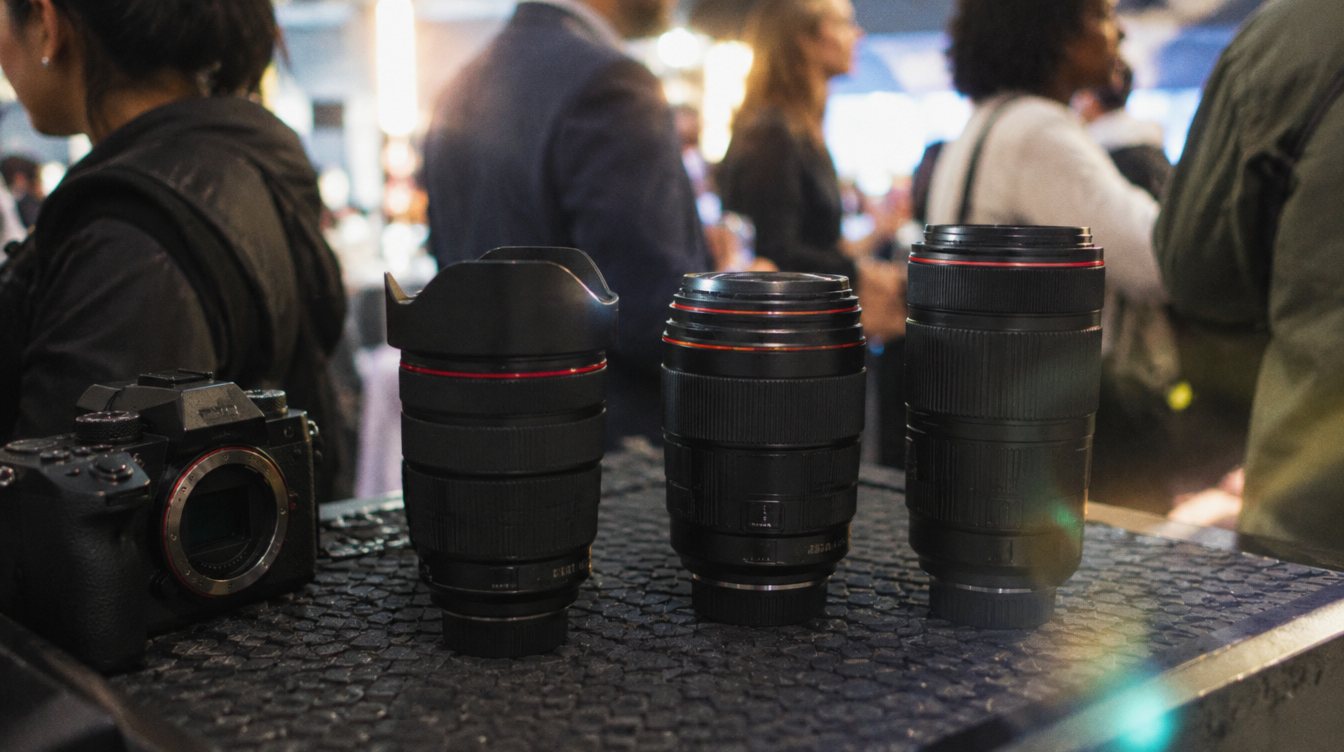
- Buy a stabilized standard zoom first: the RF 24-70mm f/2.8 L IS USM for most shooters, the RF 24-105mm f/4 L IS USM on a tighter budget, or the RF 24-105mm f/2.8 L IS USM Z if video is your whole business.
- Second, add the RF 70-200mm f/2.8 L IS USM Z for ceremonies, speeches and stages you cannot walk up to.
- Third, a fast prime (35mm or 50mm f/1.4 L VCM, or the 85mm f/1.2 L) for interviews and dark rooms. Wide zooms come last for most event and interview work.
Canon's RF L-series lenses are the backbone of our kit. Our cinema bodies, the Canon EOS R5 C and C50, have no sensor-shift stabilization, which shapes how we think about glass: stabilized zooms for anything handheld, primes for anything supported. This guide is a buying order for video shooters on the RF mount, with current price ranges from US retailer listings. Prices move often, so treat every number as "around" and check before you buy.
What makes a lens good for video (not just photos)
A lens can be excellent for stills and frustrating for video. Before comparing models, know what matters when the camera is rolling:
- Optical stabilization, especially on bodies without IBIS
- Quiet, smooth autofocus that does not hunt during a shot
- Minimal focus breathing (the frame shifting size as focus changes)
- Constant aperture through the zoom range, so exposure does not shift as you zoom
- Internal zoom or constant length, which keeps a gimbal balanced
- Weight you can hold through a six-hour event
No single lens checks every box. The buying order below is about covering the most real shots with the fewest lenses.
Typical US retail prices, late 2026 (prices change)
First lens: a stabilized standard zoom
Most event and interview footage lives between 24mm and 105mm. Wide enough for a room, tight enough for a face. A stabilized standard zoom covers a whole wedding or conference on its own, and on a body without IBIS, the lens stabilization is what makes handheld footage usable.
Standard zoom
Canon RF 24-70mm f/2.8 L IS USM
Best for: the one lens that covers most event and interview shots.
- Aperture
- f/2.8 constant
- Stabilization
- Optical IS
- Price
- Around $2,500 to $2,600
- f/2.8 for dim rooms
- Stabilized for handheld work
- The classic event range
- Extends as it zooms, so gimbal balance shifts
- Stops at 70mm for tight details
RF 24-70mm f/2.8 L
- One full stop brighter
- Better in dark receptions
- Shallower depth of field for interviews
- Costs more
RF 24-105mm f/4 L
- Longer reach to 105mm
- Lighter and less expensive, around $1,300 to $1,400
- Fine outdoors and in well-lit rooms
- Struggles more in dark venues
If video is most of your work, look hard at the RF 24-105mm f/2.8 L IS USM Z. It keeps f/2.8 all the way to 105mm, its length stays constant as you zoom (which keeps a gimbal balanced), and it accepts Canon's PZ-E2 power zoom adapter for smooth motorized zooms. The tradeoffs are weight, at roughly 1.3 kg, and price, around $3,000 to $3,300, plus around $1,000 or more for the adapter.
Second lens: the RF 70-200mm f/2.8 L IS USM Z
A 70-200 is the lens for moments you cannot walk into. Vows from the back of the aisle. A keynote from the riser. A toast without putting a camera in someone's face. On a two-camera event, one body usually lives on a long zoom.
Telephoto zoom
Canon RF 70-200mm f/2.8 L IS USM Z
Best for: ceremonies, speeches and stage coverage from a distance.
- Aperture
- f/2.8 constant
- Stabilization
- Optical IS
- Zoom design
- Internal zoom
- Price
- Around $2,800 to $3,300
- Length does not change when zooming
- Stabilized for monopod and handheld use
- Compresses busy backgrounds
- Heavy for a full day handheld
- Expensive as a second lens
Put a 70-200 on a monopod for ceremonies and speeches. You get most of the steadiness of a tripod and can still move when the processional changes direction.
Third lens: a fast prime for interviews and low light
Primes earn their place on interview sets and in dark venues. A wider aperture lets in more light and gives softer backgrounds, which is the look most clients picture when they say "cinematic." Because these primes are not stabilized, use them on a tripod, slider or gimbal.
| Lens | Where it shines | Around |
|---|---|---|
| RF 35mm f/1.4 L VCM | Environmental interviews, gimbal walkthroughs, dance floor from inside the crowd | $1,400 to $1,650 |
| RF 50mm f/1.4 L VCM | Medium interview frames, details, a natural field of view | Around $1,300 and up |
| RF 24mm f/1.4 L VCM | Wide gimbal shots and tight rooms | Around $1,300 and up |
| RF 85mm f/1.2 L USM | Tight interview close-ups with very soft backgrounds | $2,300 to $2,700 |
The VCM primes use a voice coil motor for focusing and were designed for hybrid photo and video shooters. For a first prime, a 35mm or 50mm covers the most ground. Our guides to lighting an interview with three lights and shooting in low light show how a fast prime fits each job.
Later: the wide zoom
The RF 15-35mm f/2.8 L IS USM, around $2,100 to $2,600, is the lens for venue reveals, real estate style room shots and tight getting-ready spaces. It is a great lens, but for most event and interview shooters it is the fourth purchase. A 24mm wide end covers the majority of rooms.
A buying plan by budget
- Starting out
RF 24-105mm f/4 L. Learn the range, learn what you wish you had.
- Working events
Move to the RF 24-70mm f/2.8 L for low light, then add the RF 70-200mm f/2.8 L Z.
- Adding interviews
Add a 35mm or 50mm f/1.4 L VCM. Use it on a tripod with controlled light.
- Video-first business
Consider the RF 24-105mm f/2.8 L Z with the power zoom adapter as your main lens, and keep primes for interviews.
Buy the lens that covers the shots you are missing, not the one with the best reviews.
Renting before buying is a smart move with any lens over $2,000. Rent for a real job, then decide. For camera bodies to pair these with, see our notes on the Canon EOS R5 C and the Canon EOS C50.
Frequently asked questions
What is the best first RF L lens for video?
A stabilized standard zoom. The RF 24-70mm f/2.8 L IS USM suits most shooters, and the RF 24-105mm f/4 L IS USM is the lower-cost option.
Do I need stabilized lenses if my camera has IBIS?
It helps less, but lens stabilization still adds steadiness at longer focal lengths. On bodies without IBIS, like the R5 C and C50, it matters a lot more.
Are RF L primes good for event video?
Yes, on a gimbal, monopod or tripod. They are not stabilized, so they are less forgiving handheld.
Is the RF 24-105mm f/2.8 L Z worth it?
If most of your work is video, often yes: constant f/2.8, constant length for gimbals and power zoom support. If you shoot a lot of stills or travel light, the RF 24-70mm f/2.8 L is easier to carry.
Can I use EF lenses on an RF camera?
Yes, through Canon's EF to RF adapters. It is a good way to build a kit on a budget before moving to RF L glass.