The short answer
- Uplighting colors the walls and sets the mood. Washes flood a stage or dance floor with even color. Moving heads are motorized fixtures that move, change color and project patterns for energy.
- Most events use uplighting for the room plus washes and moving heads for the stage and dance floor, all controlled over DMX by an operator.
- Our rate card: uplighting $65 per light, and stage and dance floor lighting from $1,495 with moving heads, washes, DMX control and an operator.
Lighting is the fastest way to change how a room feels. The same hotel ballroom can look like a conference hall at 2 PM and a gala at 8 PM, and the difference is almost entirely light. You do not need to know how to program a lighting console to plan an event, but knowing the main fixture types helps you ask for the right thing and read a quote.
The three families of event lighting
Nearly every event lighting plan is built from three jobs: light the room, light the stage, and light the dance floor. Each job uses different fixtures.
| Fixture | What it does | Where it goes |
|---|---|---|
| Uplight | Washes a wall, column or drape with color from the floor up | Around the room perimeter |
| Wash | Floods an area with soft, even color | Stage, dance floor, truss |
| Moving head | Motorized fixture that pans, tilts, changes color and often projects beams or patterns | Truss or stands around the stage and dance floor |
| Pinspot | Narrow beam aimed at one object, such as a centerpiece or cake | Ceiling or truss above tables |
| Gobo projector | Projects a pattern, logo or monogram onto a wall or floor | Aimed at a wall, floor or dance floor |
| Front light | Lights speakers' faces evenly so they can be seen and filmed | In front of the stage, angled down |
Uplighting: the room
Uplights are small fixtures, usually battery powered and wireless today, placed on the floor against walls or columns and aimed up. They turn beige walls into color and give the whole room a mood. Because they sit on the floor and need no rigging, they are the most cost-effective way to transform a space.
How many do you need? A rough starting point is one light every 6 to 10 feet of wall you want colored, plus one at the base of each column or architectural feature. Smaller rooms may only need 8 to 12. Large ballrooms often use 20 to 40.
Pick one or two colors, not a rainbow. A single brand color or a warm amber reads as intentional. Too many colors at once makes a room look like a nightclub at closing time.
If you want to know more about the gear itself, our battery uplights buyer's guide covers what to look for. Couples planning a wedding can see our wedding uplighting cost guide, where uplighting is a package upgrade at a lower per-light price.
Washes: the stage and the floor
A wash light covers an area evenly with color. On a stage, washes give the background and performers color and depth. On a dance floor, they fill the space with color that can shift with the music.
Washes are different from front light. Colored washes look great to the eye, but cameras and guests need even, natural-looking light on faces. If anyone is speaking, being photographed or being streamed, the stage needs front light as well. Our livestreaming guide explains why this matters so much on camera.
Moving heads: energy and motion
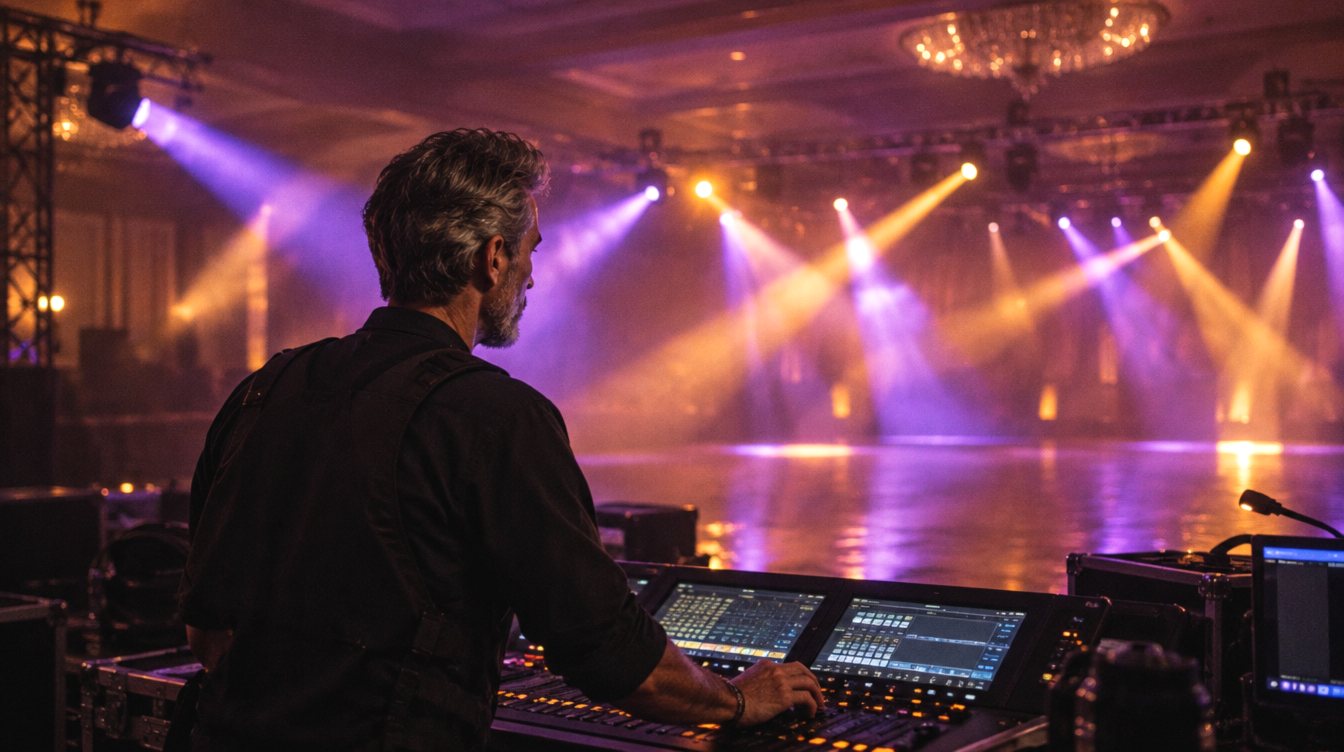
Moving heads are the lights you notice. They pan and tilt on motors, change color instantly, and depending on the model, throw tight beams, soft washes or projected patterns called gobos. Swept across a dance floor or a haze-filled stage, they create the motion that makes a party feel alive.
Uplighting alone
- Sets the mood for the whole room
- Quiet, elegant, stays put all night
- Fits dinners, receptions and networking events
- No operator needed once it is set
Uplighting plus stage and dance lighting
- Mood for the room, plus energy where the action is
- Lights change for the program, the reveal and the dancing
- Fits galas, launches, award shows and any event with dancing
- Run live by an operator over DMX
Haze is worth a mention. Beams from moving heads only show up in the air when there is a little haze in the room. Many venues restrict haze and fog because they can trigger smoke detectors, so always ask the venue before planning around beam effects.
DMX and the operator
DMX is the control standard most professional event lighting uses. It lets one controller or computer run every fixture: color, brightness, movement and timing. With DMX, a lighting operator can save "looks" for each part of the night (walk-in, dinner, program, reveal, dancing) and switch between them on cue.
That is why the operator matters as much as the fixtures. Programmed lights with no one running them either sit on one look all night or cycle randomly, which can clash with a speech or a slow song. An operator who follows the run of show makes the lights feel like part of the event.
Lights should follow the night. Bright for the speeches, warm for dinner, alive for the dancing.
What event lighting costs
Here is how lighting adds up on our corporate and private event rate card. Uplighting is $65 per light. Stage and dance floor lighting starts at $1,495 for a 4-hour event and includes moving heads, washes, DMX control and an operator.
Lighting on our rate card, 4-hour event
A typical gala of 200 to 300 guests might pair 20 uplights ($1,300) with stage and dance lighting ($1,495), for $2,795 in lighting. Setup and strike are included within 75 miles of Los Angeles. See the full production toolkit for everything else that goes with it.
Questions to ask about any lighting quote
- How many fixtures of each type, and where will they go?
- Is an operator included for the full event, or only for setup?
- Are the uplights battery powered, or will cords run along the walls?
- Is there front light for speakers, photos and video?
- Does the plan need haze, and does the venue allow it?
- How early does setup start, and does the venue allow that load-in time?
Frequently asked questions
What is the difference between uplighting and a wash?
Uplighting sits on the floor and colors walls and columns around the room. A wash light floods a stage or dance floor with even color. Many events use both.
How many uplights does a ballroom need?
Start with one light every 6 to 10 feet of wall plus one per column. Many ballrooms land between 20 and 40. A floor plan or a few photos lets a lighting team give you an exact count.
Do moving heads need haze?
No. They still add color and motion without it, but beams only show in the air with a little haze. Always check whether the venue allows haze first.
Can lighting match our brand colors?
Yes. Modern LED fixtures mix almost any color, so brand colors are usually easy. Send your brand colors in advance, since some shades look different on a wall than on screen.