The short answer
- A good recital video uses at least two or three cameras: a locked-off wide of the full stage plus operated cameras for closer shots, edited into one finished show.
- Clean audio from the sound board, a camera position agreed with the venue, and a copy of the run of show matter as much as the cameras.
- Our recital filming starts at $2,495 per show, or $45 per student (50 minimum) so the studio pays nothing up front.
A recital is one night that families remember for years. The video is how they remember it. For a studio, it is also a marketing asset, a keepsake parents will pay for, and a record of what your dancers achieved that season.
Our founder, Ceasare Orlando, started in dance. He was teaching at 13 in a dance company he and his mom started in 1998, long before he picked up a cinema camera. So this guide is written from both sides of the stage: what dancers and teachers want to see, and what it takes to film it well.
What a good recital video looks like
Parents want to see their child. Teachers want to see the choreography. Those two goals pull in different directions, and the edit has to serve both.
Single wide camera
- Shows the whole stage and formations
- Inexpensive and simple
- Dancers are small in the frame
- Hard to watch for a full show
Multi-camera edit
- A wide for formations, closer angles for faces and feet
- Cut together so it feels like a broadcast
- Every dancer still gets wide coverage as a safety
- Takes editing time, so it costs more
A good multi-camera edit stays wide when the formation is the point and cuts closer when a soloist or small group is featured. It never cuts so fast that you lose track of the choreography. Dancers notice when an edit hides a great moment.
Camera positions
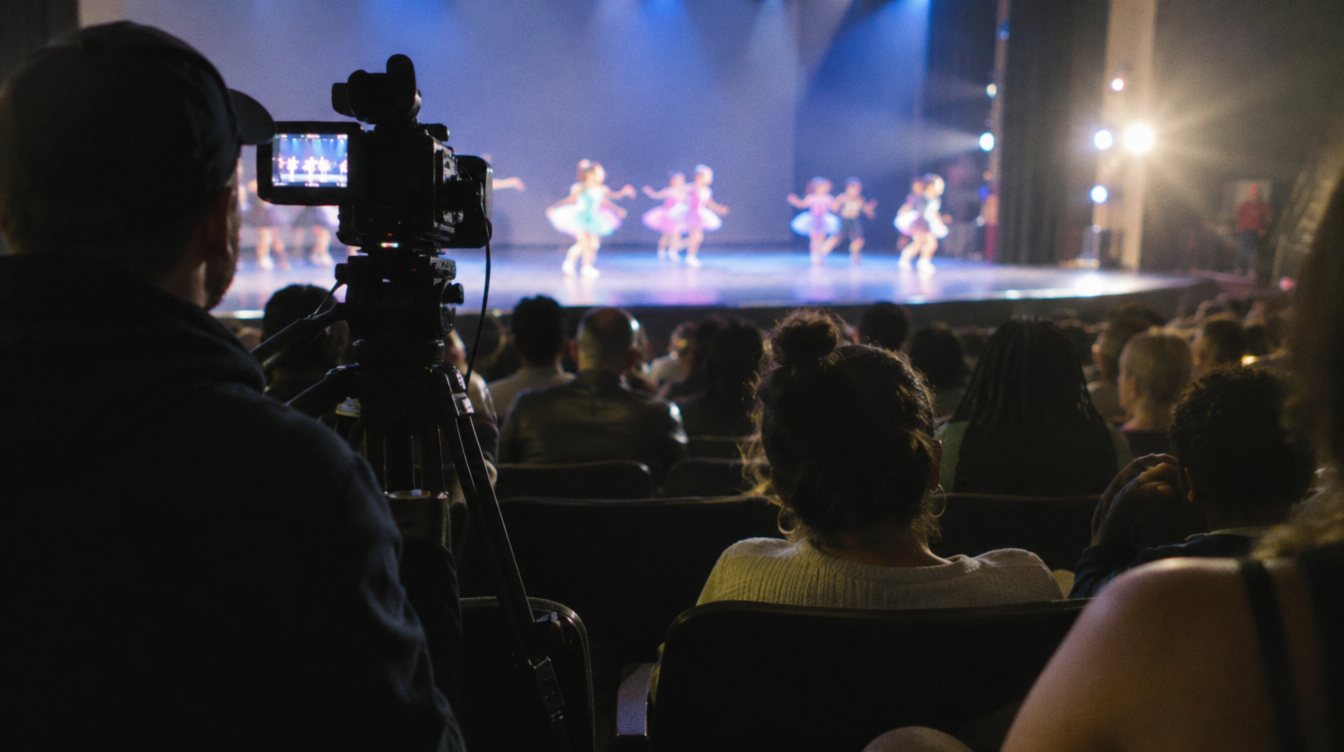
Every venue is different, so walk the house before show day if you can. A typical three-camera setup looks like this:
| Camera | Position | Job |
|---|---|---|
| Camera A (wide) | Center of the house, raised, behind the audience | Locked-off full-stage shot from curtain to curtain. Rolls the entire show. |
| Camera B (medium) | Center or slightly off-center, near Camera A | Operated. Follows groups and soloists at waist-up to full body. |
| Camera C (side angle) | House left or right, or the balcony | Operated. Faces, footwork and a second angle for transitions. |
Center matters because choreography is set for the audience in front. A side angle is beautiful for some pieces and confusing for formation-heavy numbers, so use it selectively in the edit.
Ask the venue for a camera position before tickets go on sale. If you need to hold seats for a riser or tripod, it is far easier to block them early than to move families on show night.
Lighting and exposure on stage
Stage lighting is designed for the eye in the room, not for a camera. Bright spotlights next to dark wings, saturated colors and fast cues all challenge exposure. A few practical points for whoever is filming:
- Expose for the dancers' skin, not the dark stage around them
- Watch for blown-out costumes under a white spot, especially sequins and white tutus
- Saturated red and blue washes can lose detail fast; protect highlights
- Avoid auto exposure that pumps every time a cue changes
- Get the lighting cue sheet or watch the dress rehearsal if possible
Cinema cameras with strong low-light performance and wide dynamic range help a lot here. Our guides on shooting in low light and camera settings for event video go deeper for anyone filming their own shows.
Sound
Recital audio should be the music, clean, with the applause. Camera microphones in a theater pick up crinkling programs, crying siblings and the person next to the camera cheering. The better source is a feed from the sound board, recorded separately and synced in the edit, with a room mic for applause and atmosphere. Talk to the venue's sound tech in advance; most are happy to help if you bring the right cable and ask early.
Families forgive a soft shot. They do not forgive the music sounding like it was recorded from the parking lot.
A show-day plan
Here is a sample timeline for a 6:00 PM show. Your venue's load-in rules set the real times.
- Load in
Cameras, tripods and audio go in. Confirm positions with the stage manager.
- Sound check with the board
Test the audio feed with a track from the show.
- Dress rehearsal or tech run
The best chance to learn lighting cues and test exposure.
- House opens
Cameras set, cards and batteries fresh, run of show in hand.
- Show
Wide camera rolls continuously. Operated cameras follow each number.
- Swap cards and batteries
Back up footage if time allows.
- Strike and back up
Footage is copied to two drives before anyone leaves. Our memory card and backup workflow explains why.
How studios pay for recital video
There are two common models, and both work.
With a flat fee, the studio pays for the show and decides how to share it, often building the cost into recital fees. With per-student pricing, the cost scales with the size of your program and the studio pays nothing up front. Many studios already collect a recital or costume fee, so adding the video there is simple for parents.
Our recital filming includes multi-camera capture and an edited full show, with a livestream add-on for families who cannot attend. You can see it alongside our other services on the content page, or tell us about your show in the project planner.
Permissions, privacy and music rights
Recitals mean minors on camera and copyrighted music, so take care with both.
- Include a photo and video release in your registration or recital paperwork
- Decide how the video is shared: private link, password, download or physical copy
- Keep public social posts to dancers whose families have opted in
- Ask the venue about any filming rules or fees in their contract
- Check your music licensing. Performing a song at a recital and selling or distributing a recording of it can be covered differently, so confirm with your licensing provider or an attorney.
How to brief your videographer
- Send the run of show
Number order, piece names, dancer counts and any soloists. The edit follows it.
- Flag featured moments
Solos, senior features, a finale with the whole studio. These get extra camera attention.
- Share venue contacts
Stage manager and sound tech names and numbers.
- Set the delivery plan
Full show only, or also individual numbers? Private link or downloads? Settle it before show day.
- Agree on turnaround
Families want it quickly. Ask for a date in writing.
Frequently asked questions
How many cameras does a dance recital need?
Two is the practical minimum for a watchable edit: a locked wide and one operated camera. Three gives the editor real choices and a side angle for featured pieces.
Can you livestream a recital?
Yes, if the venue has a reliable internet connection or you bring one. We offer livestreaming as an add-on to recital filming. Check the venue's rules and your music licensing first, since streaming publicly is a different use than a private recording.
Should we film the dress rehearsal too?
It helps. A rehearsal gives the crew a look at lighting cues and can provide backup angles for the edit, especially for fast numbers.
How do families receive the video?
Most studios now use a private online link or downloadable file. It is faster and cheaper than discs, and families can watch on a phone or TV.